eSIM Basics & Setup
How to Choose the Right eSIM Plan: A Complete Guide — Validity Period, Data Usage and Pre‑Purchase Checks
.png)
Introduction: Choosing an eSIM Plan Isn’t About Buying the Most Data. It’s About Picking the Right Connection for Your Needs.
As eSIM technology grows more mainstream, a growing number of users are making the switch to digital mobile‑data solutions. Compared with traditional physical SIM cards, eSIM delivers far greater connectivity flexibility. You can buy your plan ahead of your trip, install the profile in advance, and go online whenever you need it — no waiting for a physical SIM, and no manual card swapping required.
That said, more options don’t always mean an easier decision. With countless eSIM plans on the market, many shoppers struggle to figure out which one truly fits their needs. Plans vary widely in validity length, data allotment, activation policies, and device requirements. If you select a plan purely based on price or total GB, you may easily end up with a product mismatched against your real‑world usage.
This guide walks you through three key dimensions for picking an eSIM plan. First, we cover how to select a suitable validity period, including short‑term, mid‑term and long‑term options. Next, we break down typical data‑use patterns and outline approximate data needs for different user profiles. Lastly, we go over critical pre‑purchase checks: eSIM device compatibility, carrier‑lock status, activation terms, and safe‑keeping of your installation credentials.
The core goal is straightforward: pick an eSIM plan built for your lifestyle, not just one with an impressive number advertised on the page.
Section1: Choose an eSIM Plan Based on Validity Period, Not Just Price and Data Size
First-time eSIM buyers typically focus on two factors above all else: price and data allowance. Most shoppers immediately ask how much a plan costs and how many gigabytes it includes. However, after using eSIM in real scenarios, many users realize their overall experience depends far less on total data volume and far more on whether the plan covers their entire required usage window.
A common issue occurs when users pick a plan that precisely matches their original itinerary. If their trip is scheduled for several days, they select an eSIM with the exact same number of valid days. Yet real-world plans often change unexpectedly. Trips can get extended, business visits can run longer than planned, and schedules can shift due to weather, transportation delays, or personal arrangements. Once your eSIM validity expires, leftover data no longer matters — your mobile connection simply stops working. This is why the validity period should be one of your top priorities when selecting an eSIM plan.
Before asking “How much data do I need?” start with a more critical question: “How long will I need reliable eSIM connectivity?”
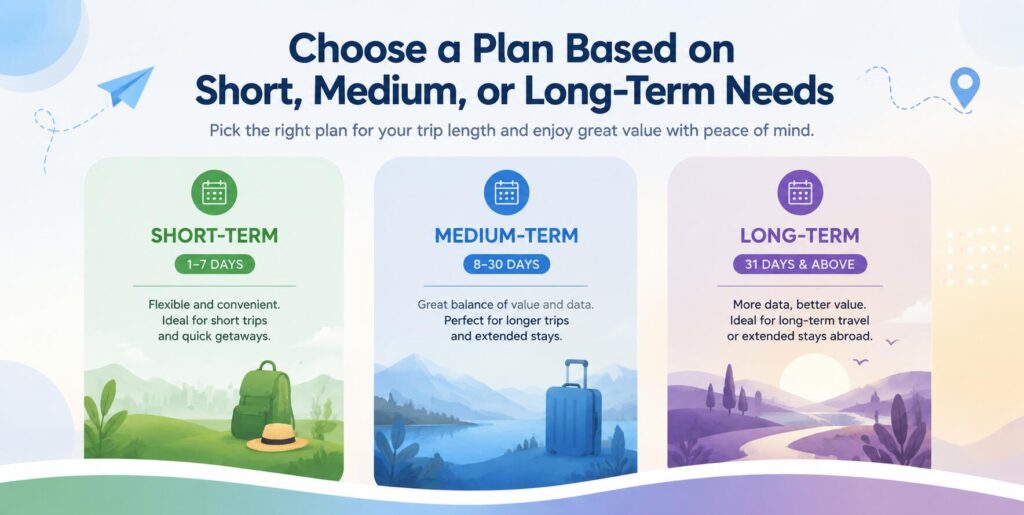
eSIM plans generally fall into three duration-based categories: short-term, medium-term, and long-term. No single option works for everyone. The best choice depends entirely on your travel schedule, lifestyle, and flexibility needs.

1.1 Short-Term eSIM Plans: Ideal for Fixed Trips and Defined Usage Windows
Short-term eSIM plans are designed for users who need dependable connectivity for a few days up to one week. Their biggest benefit is cost-effective pricing: you only pay for the days you actually use, instead of covering weeks or months of unused service.
Short getaways, temporary visits, quick business trips, and single-weekend events rarely require massive data volumes. Most users just want consistent, working mobile access whenever they need it. In unfamiliar locations, mobile data powers essential daily tasks: navigation, real-time information searches, messaging, location confirmation, and online services. Short-term eSIMs deliver exactly what casual users need: stable, reliable connectivity with no long-term commitment. Unlike traditional monthly phone plans, eSIMs let you customize coverage to fit your exact schedule.
If your itinerary is fixed and fully predictable, a short-term plan is the most efficient choice. If your plans might shift, opting for a slightly longer validity period ensures seamless connectivity and greater peace of mind.
1.2 Medium‑Term eSIM Plans: The Balanced Pick for Most Users
For a large share of users, medium‑term eSIM plans strike the ideal balance of flexibility, cost‑efficiency, and convenience. They avoid the tight constraints of short‑term options, yet do not demand the lengthy commitment required by long‑term plans.
Today’s travel and work arrangements have grown far more flexible. Plenty of people do not only need data for a handful of days, but they also have no use for a permanent mobile‑data solution. What they require instead is dependable connectivity for a defined stretch of time. Common scenarios include longer‑duration vacations, temporary overseas stays, extended business travel, or periods spent moving across multiple locations.
The greatest advantage of medium‑term plans lies in their added flexibility. Users no longer need to keep constant track of their expiry date or stress over buying a replacement plan mid‑trip. A solid mobile connection should operate quietly in the background — supporting your daily tasks without turning into another item on your to‑do list.
For most regular users, medium‑term options deliver a practical sweet spot between cost and convenience. They deliver sufficient time‑frame coverage, without forcing you to pay for much longer service windows you will never fully use.
1.3 Long‑Term eSIM Plans: Ideal for Users Needing Ongoing Reliable Connectivity
Long‑term eSIM plans cater to people who require consistent mobile data over an extended time frame. For these users, internet access is no longer an occasional need — it is built into their day‑to‑day routine. They rely on their devices daily for online tasks, messaging, navigation, account administration, work‑related duties, or staying connected while moving across multiple locations.
Repeatedly buying short‑term plans quickly becomes cumbersome for this group. Every renewal means researching available options, setting up a new plan profile, and keeping track of yet another expiry date. The core value of long‑term eSIM plans lies in cutting down this repetitive overhead. Once activated, the plan delivers uninterrupted service for a much longer span, so users can focus on their daily life rather than troubleshooting or managing their mobile connection.
These plans work especially well for long‑term residents, remote workers, frequent travelers, and anyone who cannot consistently count on public Wi‑Fi. For such users, the appeal of a long‑term plan is not just about total data allowance. It also brings the peace of mind of having one fewer item to keep on their radar.
1.4 How to Quickly Pick the Right eSIM Validity Period for Your Needs
Figuring out your ideal eSIM duration does not require complex calculations.
Begin by asking yourself three straightforward questions:
Short‑term plans generally suffice if you only require connectivity for a handful of days. Medium‑term options may work better when you want full‑trip coverage plus extra flexibility. Long‑term plans are typically the most convenient choice for anyone needing ongoing connectivity and wishing to skip repeated plan purchases.
A longer validity period does not always equal a better choice. An overly lengthy plan can leave you paying for days and data you will never consume. On the flip side, picking one that is too short may result in lost connectivity if your plans shift unexpectedly. Your best bet is to select a plan that aligns with your real‑world requirements while building in a little extra flexibility. A well‑chosen eSIM plan should not force you to keep checking how much valid time remains. It simply keeps you connected whenever you require service. Once you have settled on your ideal eSIM validity period, the next step is figuring out how much data you actually need.
- How long will I actually need mobile‑data service?
- Is there a chance my schedule could shift?
- Do I want to avoid purchasing another plan mid‑trip or during my stay?
Section 2: Choose an eSIM Plan Based on Data Usage, Not Guesswork
Once you have picked the correct validity period, the next key question becomes: “How much data do I actually need?”
This is a common pain point for many shoppers. Pick too little data, and you could hit your limit right when you need connectivity the most. Opt for too much, and you end up overpaying for data you will never consume. There is no one‑size‑fits‑all answer. Two people may use an eSIM for the exact same number of days yet see completely different data‑consumption levels. The gap does not come down to how frequently you pick up your phone. It hinges on what activities you actually do on your device. Many users feel they are “using their phone heavily,” without realizing which actions burn through the most data. Navigation, messaging, and web searches generally eat up very little data. By contrast, video streaming, mobile hotspot sharing, file uploads, and photo syncing consume far larger volumes.
This is why picking your eSIM plan starts with knowing your own usage habits, rather than just grabbing the largest‑size data package on offer.
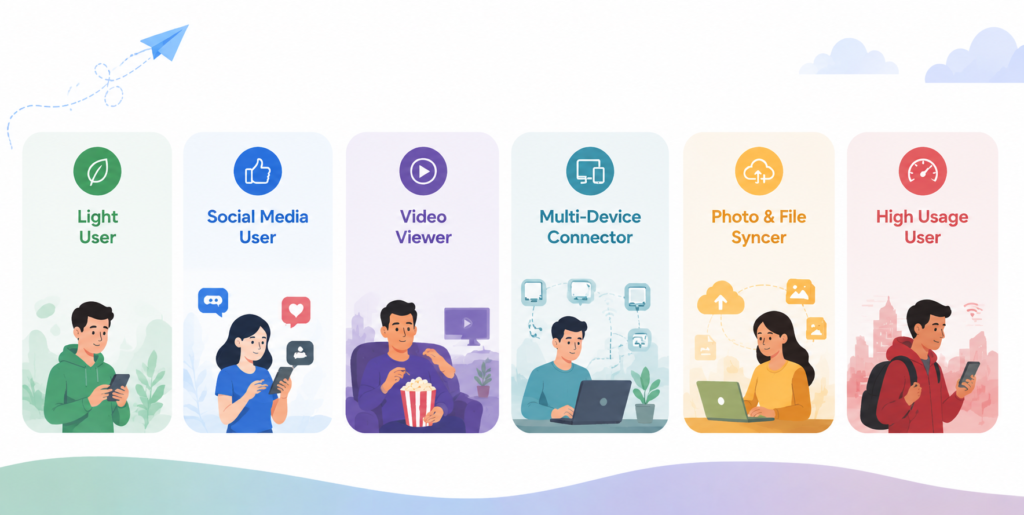
2.1 Basic Connectivity Users: Stay Online Without Overpaying for Unneeded Data
Some people get an eSIM primarily to keep their phone working when public Wi‑Fi is out of reach. They do not require high‑volume data; they just want dependable connectivity whenever it is needed.
Typical activities for this user group include:
These tasks are essential, yet they generally consume very little data. The most common pitfall for basic‑connectivity users is purchasing far more data than they actually require. Larger plans might feel like the safer pick, but when most of your data allowance goes unused, the extra spend delivers little real‑world value. If your core needs are staying reachable and completing routine online tasks, a small or mid‑size data plan may already be sufficient.
- Viewing maps and navigation directions
- Sending instant messages
- Running web searches
- Checking email
- Looking up weather forecasts or local‑service information
2.3 Video and Entertainment Users: Streaming Can Rapidly Shift Your Data Requirements
Video content ranks among the biggest mobile‑data consumers. Whether you are watching streaming platforms, live streams, online courses, or casual entertainment clips, continuous playback can eat through your available data allowance in no time. Many users underestimate this impact, assuming they will only watch “a little” video. Yet real‑world usage often turns out differently.
Long airport layovers, extended road trips, or multiple hours without Wi‑Fi can make video streaming your top source of data consumption. Video quality also plays a critical role: high‑definition streams use far more data than standard‑definition playback. If you frequently stream video on your device, picking a plan sized for ordinary browsing habits may leave you running out of data prematurely.
For this group of users, a larger data allotment delivers greater freedom and fewer usage restrictions.
2.4 Work‑Focused Users: Reliable Connectivity Matters More Than Raw Data Volume
For people who use their phones for work, an eSIM is not simply about having extra data. It is about maintaining a reliable connection when they need it.Mobile work situations can include checking emails, joining online meetings, accessing cloud platforms, uploading files, managing accounts, or staying connected while moving between locations.These activities may not always consume huge amounts of data, but they are often more important than casual browsing. A weak connection at the wrong moment can interrupt work and create unnecessary problems.
Another common situation is using a phone as a hotspot. Many professionals connect laptops or tablets when Wi-Fi is unavailable, turning their mobile connection into a temporary workspace.However, hotspot usage can change data consumption dramatically. Activities that are light on a phone may use much more data on a computer, including software updates, file downloads, cloud syncing, and video meetings.
If your eSIM is mainly for work, choosing a plan with enough data flexibility is more important than simply choosing the lowest-priced option.
2.5 Multi‑Device Users: Hotspot Sharing Can Completely Transform Your Data Consumption
More users are leveraging their phones as portable internet gateways. Whether you are tethering a laptop on a business trip, pairing a tablet while traveling, or supplying temporary internet for another gadget, hotspot use brings about a drastically different data‑usage profile.
Stand‑alone smartphones generally consume less data, since mobile apps are optimized for smaller screens and limited bandwidth. By contrast, laptops and tablets frequently run bandwidth‑intensive tasks in the background. They may load full‑size web pages, trigger cloud‑file syncs, and pull automatic app updates. This explains a common user experience: data lasts perfectly well when you only use your phone, yet gets exhausted rapidly once hotspot sharing is enabled.
If your eSIM will serve multiple connected devices, do not estimate your requirements based purely on smartphone‑only usage. Build extra headroom for additional devices and their background activities.
2.7 High‑Usage Users: When Your Phone Acts as Your Primary Internet Connection
Some users depend entirely on their phone as their main source of internet access. Their daily activities span web browsing, messaging, online services, media streaming, file handling, and work‑related tasks. For this group, heavy data consumption rarely comes from a single activity. Instead, numerous smaller actions accumulate throughout the day.
A few gigabytes might look adequate at first glance, yet consistent day‑to‑day use can quickly drive up total consumption over several weeks. The biggest pain point for high‑usage users is ongoing data‑balance management. Constantly checking remaining data, restricting app usage, or avoiding certain services makes the whole mobile experience feel constrained.
Selecting a plan with ample data capacity lets you use your device naturally, without the persistent worry of hitting your data cap.
Data Usage Reference: Align Your Plan With Your Daily Habits
A plan that fits one user perfectly can feel far too restrictive for someone else. A person who only uses maps and messaging will consume minimal data, while remote workers, streaming enthusiasts, or users with multiple connected devices may require substantially more. The ideal eSIM plan supports your real‑world usage habits, so you do not have to keep a constant eye on your data consumption. Picking the correct eSIM data allowance is not about copying other people’s purchasing choices. Everyone has unique mobile‑use patterns.
Once you have a clear picture of your data requirements, the final step is completing pre‑purchase checks for both your device and your selected plan.
Section 3: What to Check Before Buying an eSIM Plan to Avoid Setup Problems
Selecting the right validity period and data allowance matters, yet many users skip one critical final step: confirming the eSIM will actually function on their device. Plenty of eSIM‑related troubles stem not from flaws in the plan itself, but from buying first and verifying compatibility afterward.
Typical pitfalls include:
These issues can be extremely frustrating, particularly when you need mobile‑data access right away. The good news is most of these headaches are preventable with a handful of quick pre‑purchase checks. No advanced technical expertise is required — you only need to verify several key details before placing your order.
- Your phone lacks native eSIM support
- The handset remains carrier‑locked
- Misunderstanding how the activation workflow works
- Losing key installation credentials
3.1 Check Whether Your Phone Supports eSIM Before You Buy
Device compatibility is the fundamental requirement for using eSIM. Many users assume all newer‑generation phones come with eSIM support, yet this is not always the case. Even identical phone models can carry different feature sets, depending on the sales region of the unit. If your handset does not support eSIM, the plan cannot be installed — even after you complete your purchase and receive your activation credentials. Before placing your order, double‑check your exact phone model and regional variant.
Most recent iPhone, Samsung Galaxy, and Google Pixel handsets offer eSIM capability. Still, verifying your specific device remains the safest practice. Do not wait until travel day or an urgent moment when you need mobile data, only to find out your phone cannot work with the service.
3.2 Confirm Your Phone Is Carrier‑Unlocked Before Switching Networks
Device carrier‑unlock status is another critical checkpoint many users overlook. In the United States, numerous phones are bought via carrier installment plans, promotional bundles, or service contracts, and some of these units retain network‑lock restrictions. Even if your handset supports eSIM, a carrier‑locked device can block you from activating a third‑party network plan.
A typical scenario plays out as follows:
More often than not, the fault does not lie with your eSIM plan. The device remains locked to its original carrier. Verifying your unlock status prior to purchase helps you avoid unexpected disruptions down the line. This check is particularly vital for anyone who acquired their phone directly from a mobile carrier.
- The eSIM profile installs successfully
- The QR code scans without errors
- Yet your phone fails to establish mobile‑data connectivity
3.3 Understand eSIM Activation Rules Before Installation
One easily‑missed detail is how the eSIM activation workflow actually operates. After buying an eSIM, many users install it right away to get everything set up ahead of travel or their planned usage. While advance preparation is generally sensible, it is critical to understand exactly when your plan’s validity window officially begins.
eSIM providers follow varying activation logic. Some plans start counting their validity period the moment the eSIM profile is installed. Others activate only after your device connects to the supported local network at your destination.
Without clear knowledge of these activation rules, you may unintentionally trigger your plan too early. For instance, you might install the eSIM several days prior to your trip, expecting validity to kick in later. If your plan activates immediately upon installation, however, portions of your service window could get used up before you actually need connectivity.
Always review the official activation instructions supplied with your eSIM plan before installation. Understanding your plan’s start condition lets you pick the optimal installation timing and ensures you receive the full value of your purchase.
3.4 Ensure the Plan Aligns With Your Real‑World Usage Needs
Many shoppers fixate solely on the total GB included when picking an eSIM. While data allowance certainly matters, it is only one piece of the decision‑making process. A 10 GB plan can deliver vastly different experiences depending on how you use your device. That same allotment may last comfortably for users who mostly rely on maps, messaging, and light web searches. Yet it can run through very quickly for anyone streaming videos, uploading content, using hotspot tethering, or working remotely.
A smaller‑size plan may suffice if you only require basic connectivity. If you depend on mobile internet for work, entertainment, multi‑device tethering, or heavy online activity, stepping up to higher data capacity will deliver a far smoother experience.
The best eSIM plan is not the one with the biggest data number. It is the one that matches your unique real‑world usage pattern.

Choose LemonSIM eSIM for a Simpler Way to Stay Connected
Picking the right eSIM plan boils down to three straightforward steps:
LemonSIM eSIM delivers flexible mobile connectivity with no physical SIM card required. Whether you are traveling, working remotely, hopping between locations, or simply need dependable mobile data when Wi‑Fi is out of reach, you can select a plan tailored to your unique needs. eSIM technology streamlines staying connected: no waiting for a physical SIM to ship, no swapping SIM trays, and no need to lock yourself into one rigid mobile plan.
Choose LemonSIM eSIM for a Simpler Way to Stay Connected.
- Figure out how long you will need network coverage
- Estimate your actual data consumption based on your daily usage habits
- Verify your device compatibility and plan details before checkout